
Zakouma National Parks elephants treated us good
Elephants are one of the attractions when you go to Zakouma National Park in Chad’s Salamat region. In this blog I will share my experience and my thoughts from the few meetings I had during the six days there.
The history of Elephants in Chad
The history in Chad is sadly the same as in many African countries. Chad had a healthy population of among 300.000 animals as recently as 1970. This has been decimated heavily due to turmoil in and around Chad. The regions instability together with a huge demand of ivory from Asia have driven the population downwards. I haven’t found any figures for Chad of recent days, but I would guess the situation have been more or less the same as in Zakouma National Park.
The ivory trade of late
In 1989 all international trade of ivory was banned and that halted the course set for the African elephant. The population started to raise again until CITES gave a go ahead for sales of ivory stockpiles in 1999 and 2008.
It was Botswana, Namibia, South Africa and Zimbabwe that persuade other CITES member states to let them opt out. The basis for this was that their elephant populations where stable or increasing. The sales was only going to be open to approved buyers i.e. countries whose enforcement in illegal trade was deemed sufficient.
Photo: Ivory where it belongs

That meant 50 tons where sold to Japan in 1999.
However, the sales of 108 ton in 2008 ended up in China as CITES approved them as a buyer during a meeting held in July 2008. ( Read: Ivory sales get the go-ahead )
These two one-off sales sparked a desire for ivory once more and acted as a fire-starter for a rise in poaching as they sent signals that the trade was up and running. Many voiced concern of the second sale in particular with China as the buying part. Sadly China was approved and the rest is history.
The crisis started earlier in Chad
The rise in poaching started early in Chad. Probably mainly due to the turmoil in the region.
In Zakouma National Park it was Janjaweed members from Sudan that travelled on horseback to raid the Park. They slaughtered the elephants found and loaded the “blood ivory” on camel trains that carried them back across the border to Khartoum and some 150 ivory carvers.
The tusks ended up as chopsticks, figurines, jewelry and so forth.
A survey made in 2005 by conservationist Esmond Bradley Martin found out that 75% of the ivory in Sudan was bought by Chinese customers. This survey predates the CITES approval of the 108 tons sold to China and show you an existing demand that was feed by the one-off sale in 2008. It is also well understood that money from blood ivory fund terrorism. ( Read: How Killing Elephants Finances Terror in Africa )
Recent history of Elephants in Zakouma National Park
At the start of the 21st century they had around 4.000 elephants in Zakouma National Park.
A decade later they had as few as 450 individuals due to poaching. When they surveyed the herd that now stuck together in thick bush they discovered something really sad. They didn’t find any elephant calves younger than 5 years of age.
The conclusions was that the poaching crisis had stopped them from breeding due to stress.
In 2010 African Parks signed a long-term agreement with the Chadian government to manage Zakouma. It was the start of a remarkable story and the start of the end to the bloodshed in and around the National Park. The poachers not only killed the wildlife inside the park, they also wreaked havoc among the local people. That meant African Parks had to step-up security both inside and outside the Park once they took over management.
Anti-poaching activity in Zakouma National Park
In 2012 African Parks expanded their anti-poaching activities sending Rangers north of Zakouma to a marsh called Heban. The reason was that they had discovered that half of the herd actually migrated to Heban during the rainy season.
In August 2012 a patrol in the Heban area came upon suspicious tracks and next afternoon they heard multiple gunshots. An airplane discovered a camp that the anti-poaching unit later raided without capturing anyone. It was indeed a camp used for poaching activities now halted and all evidence collected pointed to Sudan and the Sudanese army.
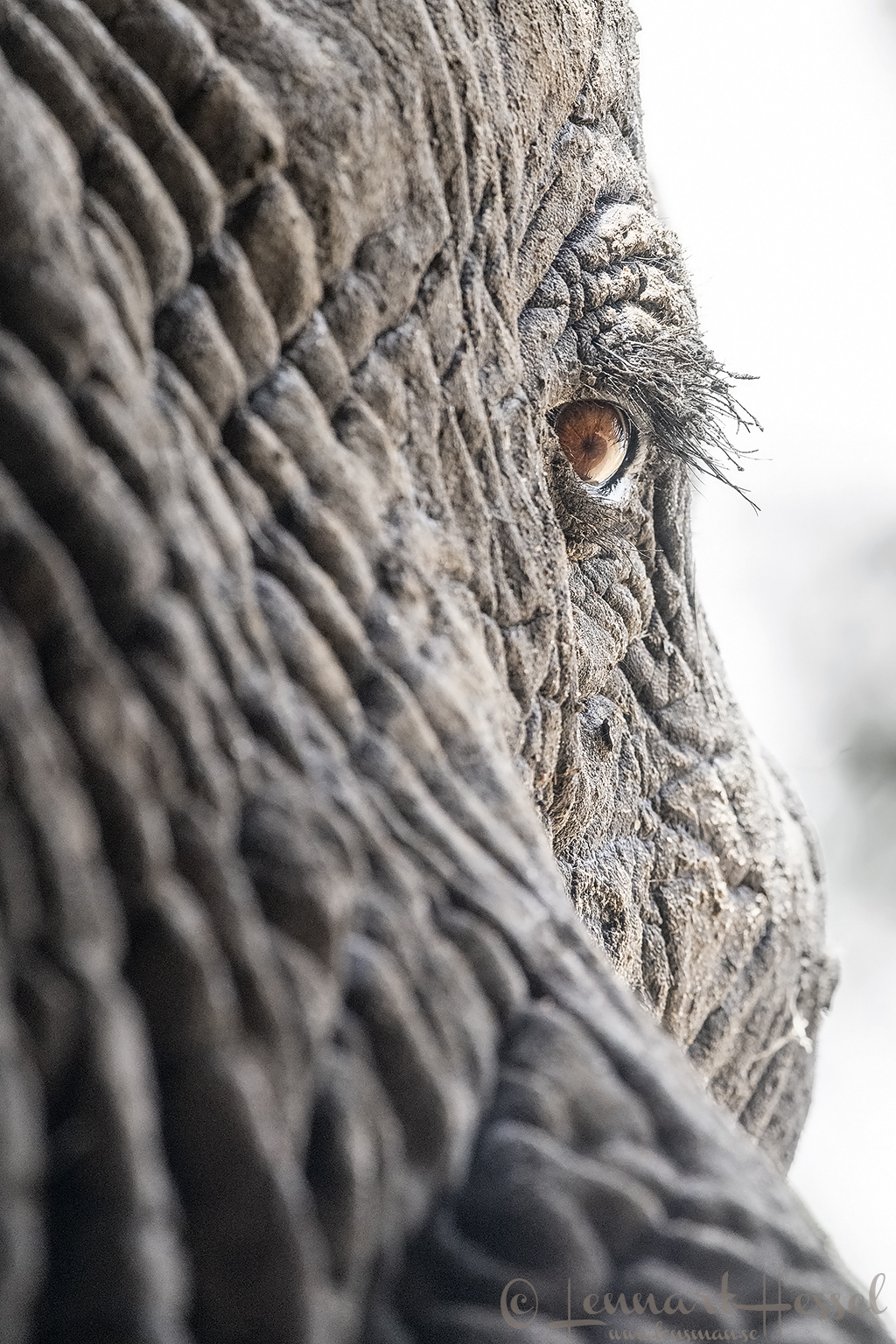
Photo: Years of wisdom in an Elephant eye

Sadly, this isn’t the end of the story as the threat hadn’t been neutralized as presumed. Instead the poachers struck back the 3rd of September during the morning prayers killing everyone except the cook, whom escaped wounded by hiding in some bushes. ( Read: “Deadly Forces, Complex Issues Sabotaging Elephant Protection in Chad” )
This sad incident is the last time a big part of the herd has migrated out of Zakouma National Park. Today the stay inside the Park giving the Rangers an easier task of monitoring them keeping a protected inside the Park.
Up until today only 24 elephants have been lost due to poaching since African Parks took reign.
Peace restored
Today peace is restored in Zakouma and the surrounding area. It has help not only given the local communities an upswing with schools, security etc. It has also been the turning point for the elephants. They are now breeding and in early 2018, African Parks counted 103 calves.
That is a significant step in the right direction, but that doesn’t mean that the traumatized elephants trust humans. They are wary to both the smell and voice of humans and the big herd still keep together inside thick bush.
You will find elephant bulls separated from the herd. These bulls show a building trust with humans around fresh water, but when you meet them elsewhere they might show traits of troubled time.
Meeting the big herd
We stayed out for a whole day trying to see the elephant herd. It took time to find them, because our signal tracker wasn’t working as it should. When we found them we saw that they were under surveillance and that a group from the other camp had gone on a game walk to see them in the forest.
That was not our desire even if it would have been a special experience.
We wanted to experience the herd out in the open to grasp the size of it. Many tend to go for the first option and I find it a little questionable. To send people into thick bush among animals that certainly don’t like your presence is a little dubious if you ask me.
We thought we had missed our opportunity with the herd, but once we decided to head back to camp late in the afternoon they decided to come out of the forest..
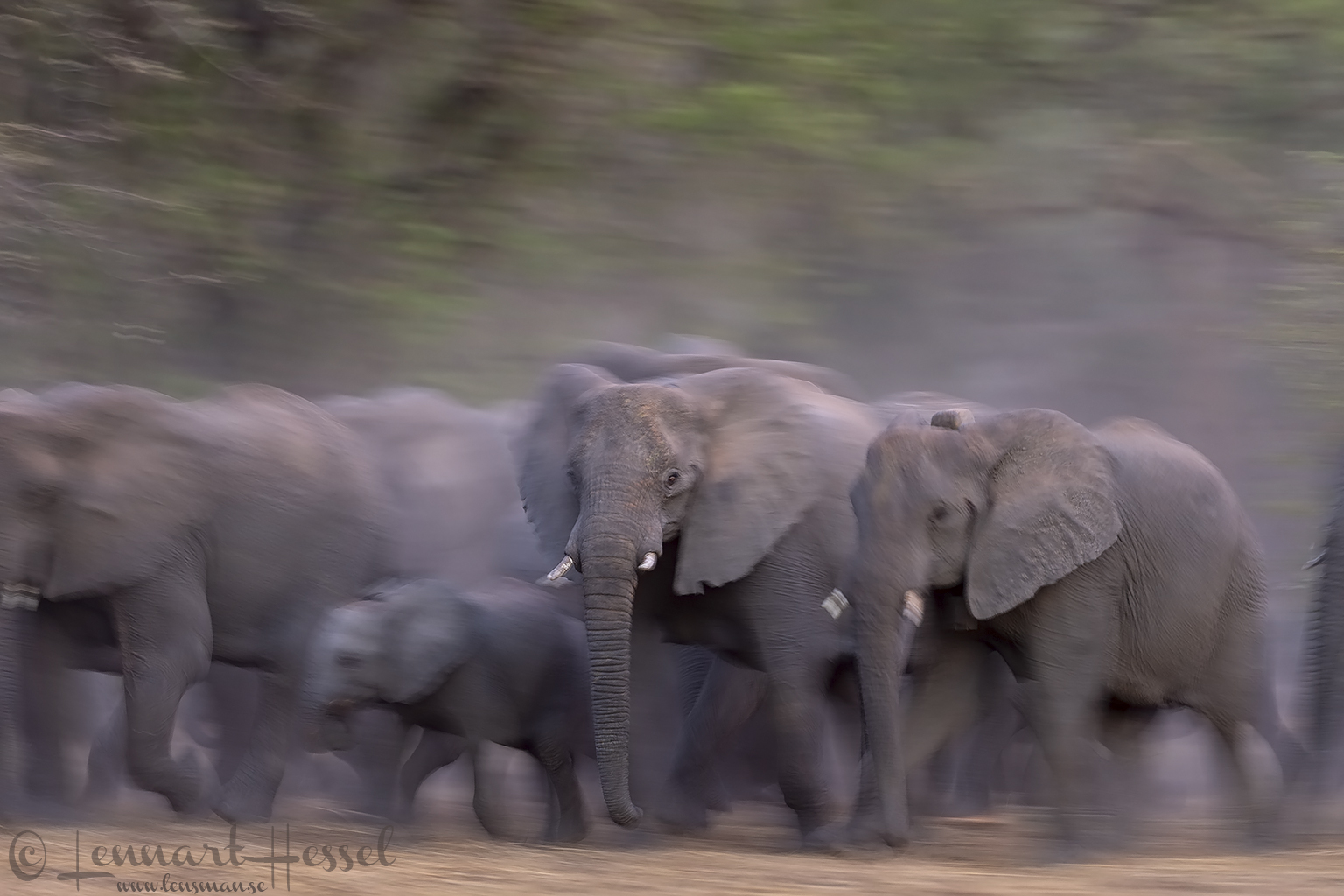
Photo: The Elephant herd moving together

It was a rewarding moment, but also a sad moment. Rewarding because we had decided to give it a proper go, being out in 40+ degrees all day long is tough, and sad, because we got to see their wary behavior. We also noticed how small tusks they all had, some even being tusk-less.
To start with they actually approached us head on until they stopped. I guess they must have picked up on our scent, because we kept dead silent.
We didn’t want to startle them by starting the engine as that might have sent them into flight. We understood they must be heading for water as they had stayed in the forest since we found them late morning. So, we just sat still and watched them decide which route to water they should take.
It took them some time to decide and during that we kept silent watching them in silence.
I photographed and recorded videos as I felt that might be the best way to show the herd and make people grasp how they act and behave.
Video: The Elephants of Zakouma National Park
This video is cut from several recordings I made. The birds you hear are the Black crowned Cranes that we found by the thousands in pans nearby.
Watering Elephants of Zakouma National Park
Our second experience with the elephants of Zakouma National Park was a closer one.
I knew about the bulls before going there and hoped of seeing them during the days there. We found them three times at elephant HQ where they have their own mud bath and sometimes get spoiled with fresh water.
On the last morning we had the pleasure of having them for ourselves. We probably spent almost 15 minutes with three bulls giving them fresh water, as well as hosing them. All of our group got their share of the action and I have of course made a video so you can see for yourself.
Video: Watering the elephants of Zakouma National Park
Please act responsible or stay at home
Sadly I also witnessed a young woman from the other camp scaring the big boy. She thought it was okay to put a cuddle toy in the face of him to get a picture of them together.
Would she accept me putting a teddy bear a couple of decimeters in front of her face just to get a photo?
I don’t think so and she would most probably become mad at me.
But the fact is she thought it was okay to pressure a traumatized animal like that? I can’t fathom how stupidly people can behave. It is beyond me and the only explanation I have to the incident is that she didn’t understand better and no one corrected her beforehand.
Instead she got to ruin the experience the group could have had and left the big boy without fresh water, which is the saddest part of this incident.
Please understand they live there and you should act like a guest you would accept at home.
Photo Album: Elephants of Zakouma National Park






9 Comments
I loved the videos! Who was bathing and water support for the elephants was you Lensman – Lennart Hessel Photography? … It was very funny, because it had one without patience, that almost took the water pipe … lol, lol
It is a younger bull that shows impatient, Jô Sá. He is a little cheeky.
Really daring … 😁🐘…lol
They are really incredible ! Congrats on the photos, footage and sharing. Maybe in another life I’ll go there to see it up close. I believe…🙌🙏
Thanks Jô Sá. I hope you get the chance to go one day.
Fascinating to see how closely they stick together. Obviously feeling the need to protect the herd. The positive thing is seeing so many calves in the herd. That must have been a wonderful experience to be so close to the bulls!
Hi Nancy.
It was a magical and tragical experience. Magical to be part off and tragical to see what you just point out. The need for protection. And yes it was very positive to see all the calves.
The bulls where a fantastic experience. To be that close to them without any barrier was truly special.
Regards /Lennart
Very informative. Must have been quite an experience.
Thanks Nancy…